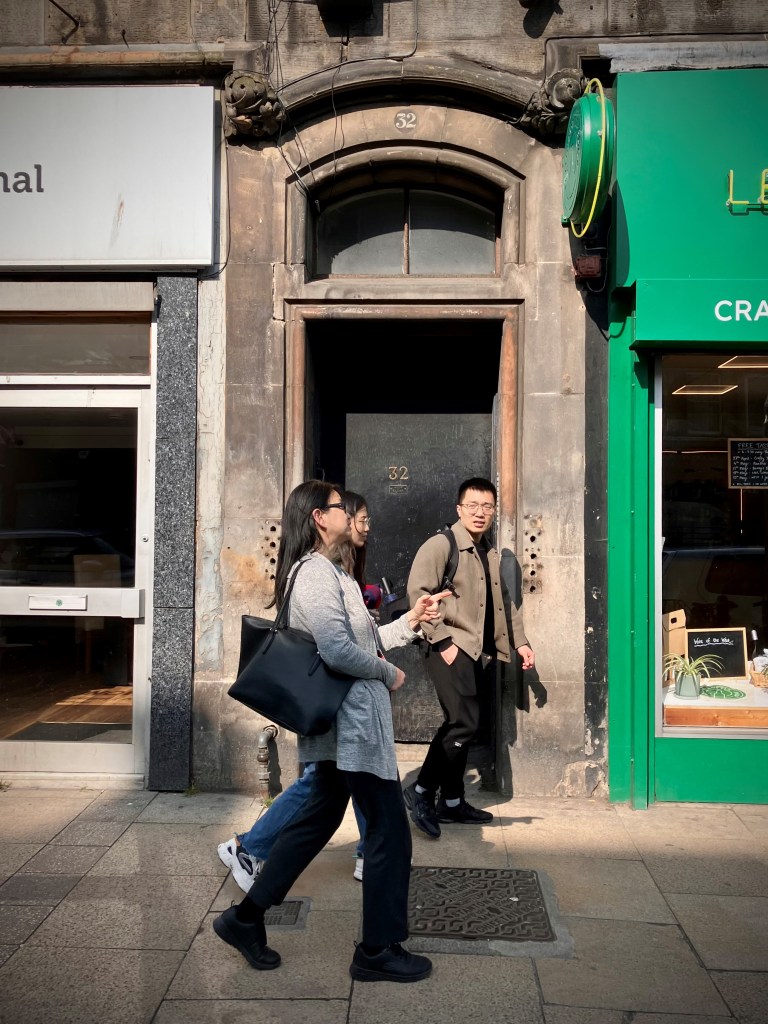
32 Great Junction Street, Edinburgh—one of a row of mid-Victorian tenements on a road that follows the line of the southern wall of the fortifications erected by the French troops who occupied Leith in the 1550s.
Notable former residents include:
1943—Mr and Mrs J Carroll, who received news that their son, Band Serjeant Francis Carroll of the Gordon Highlanders—a prisoner of the Japanese army since the fall of Singapore—had died of dysentery while working as forced labour on the construction of the Thai-Burma railway.
1925—Frank Hay, a lorry driver who was delivering ice to a confectionary shop in Galashiels when he witnessed a speeding car collide with a grocery waggon that was pulling away from the shop, hitting (though not fatally injuring) two boys who were playing nearby.
The car was driven by a chauffeur who had been transporting a local mill owner—Hugh Sykes, 2nd Baronet of Kingsknowes—to the train station. Frank testified in court to its reckless speed, confirming that it had been going at 19mph at least. The chauffeur received a £4 fine.
Three years later, Frank himself was fined 30s when he was discovered driving a car through Falkirk without being in possession of a driving licence. Despite his profession, he may never have had one.
1923—Margaret Wheelaghan, who worked in the bonded warehouse at Tanfield and took to hiding bottles of whisky in bags of waste paper and so on, retrieving them later when she was unobserved and going home with them hidden in her underwear or in deep pockets sewn into her clothes.
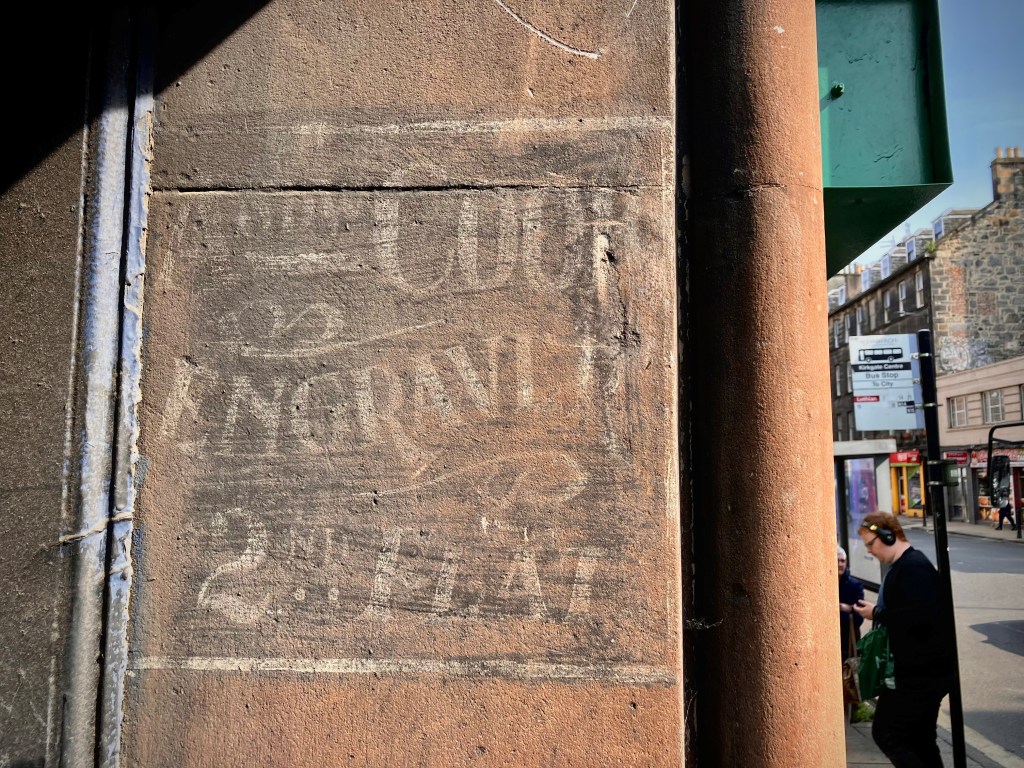
1921—Andrew Cook, engraver, who died, aged fifty-three, when a blood vessel burst in his brain. He’d once had a shop on Leith Walk, but had moved his business into the flat at Great Junction Street sometime after his daughters were born.
The signs that he painted on either side of the stair door were painted over by a subsequent resident (perhaps bothered by people coming to their door bearing trophies and medals to be engraved) but have resurfaced in the century since his death.
1920—Isabella Wheelaghan, (sister of Margaret, above), who was named in divorce proceedings brought by the wife of John Meaney, an Irish craneman who had played for Hibernian FC during the first world war, when all its best players were in the army.
The woman, Margaret Aimers, had married John in 1911, when he had been a promising young footballer with Leith Athletic. They had a child together, but soon separated—due, Margaret said, to “his habits of idleness” and to his having turned her out of the house.
She took the child to Canada, where she supported herself for some years. In 1920—presumably because she wanted to remarry—she returned to Scotland to seek a divorce, on the ground that she had learned that John had “cohabited” with Isabella Wheelaghan, a daughter of Thomas and Mary Wheelaghan of 32 Great Junction Street. That was apparently fine by John, who didn’t appear in court, and the judge granted the divorce.
1918—Benjamin Brown, a steward and cook on the SS Malvina, one of fourteen men who died when the ship was torpedoed a mile off the Yorkshire coast on its way from London to Leith. It was torn almost in two and disappeared beneath the surface in three minutes.
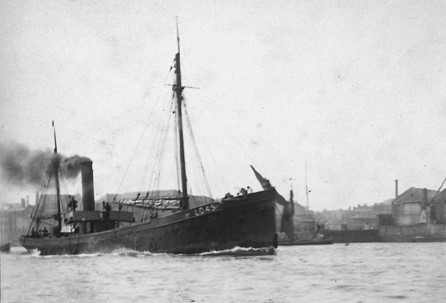
(The SS Malvina photographed on the Thames, before the war.)
The U-boat that had fired the torpedo continued on its course and was directly below the Malvina as it sank with unexpected speed. It was hit by the plummeting vessel and dragged down with it, ending up trapped in the wreckage on the sea bed. Its entire crew perished.
1915—Emily Cook (the wife of Andrew Cook, engraver, above), whose brother David Cross, a former soldier who had been working as a labourer in St Margaret’s engine works, joined a London regiment as soon war was declared and was killed at Gallipoli, thirteen months later.
1915—James Wheelaghan, (brother of Isabella and Margaret, above), who joined the Australian infantry and was killed at Gallipoli three days before Emily Cook’s brother died there. The telegrams would have arrived in the tenement around the same time.
1909—Alex Adams, a three-year-old boy staying with his grandmother, who fell into a basin of hot water on the kitchen floor and was terribly scalded. He was taken to hospital, where he died.
(A small mystery: although the Evening News report is clear that the boy died of his injuries—“SCALDING FATALITY AT LEITH”—the doctor who completed Alex’s death certificate gave the cause of death as scarlet fever, neglecting to mention the accident entirely.)
1875—Ann Mitchell, whose brother Andrew Stevenson had gone to California as a young man. She had kept in touch with him over the years, watching from afar as his fortunes rose and he became fabulously rich, but she hadn’t heard from him for a few years and was anxious for news.
The initial source of her brother’s wealth is unclear (possibly selling supplies to miners during the gold rush) but, by his sixties, he was a millionaire—a substantial shareholder in gold and silver mines in Nevada and the owner of a large property in San Francisco, where he lived.
Stevenson was a well-known figure in his new home city. “He wore none but the most irreproachable broadcloth, with white vest and clerical tie, adjusted with mathematical precision, and affected pink-tinted gloves and the most immaculate shirt bosoms.”
Also, “To the apothecaries, he was a bonanza. In the wild struggle to ward off the traces of time, he became a marvel of cosmetics and a miracle of perfumery. His enamelled face and raven locks were daily provocative of smiles from grown people and open derision from youth.”
Although he was viewed as a slightly ludicrous character—he struck people as being “like the last representative of a long-departed and forgotten dynasty of dandies”—he was well liked by his peers, and known for his generosity to friends in need.
But he was also known for “continually getting into scrapes about women,” which seems to have been a veiled allusion to some awful—in fact, criminal—behaviour, as testified to in court by a young woman named Martha McDonald, who had found herself in a desperate situation.
In 1866, when she was sixteen, Martha travelled from Scotland to California to find her brother, who had emigrated years earlier to work in the gold mines. On arrival, she contacted Stevenson because she had been told that, as a mine owner, he could help her.
It turned out he could, and she was soon reunited with her brother in Walla Walla, in the Washington territory. However, after five years, she developed inflammatory rheumatism—the worst case her doctors had seen—and her brother sent her to San Francisco for medical treatment.
When she arrived in the Cosmopolitan hotel, Stevenson—who had a suite there—happened to be in the lobby and recognised her. She didn’t remember him until he remined her of her previous visit, and she once again thanked him for helping her find her brother.
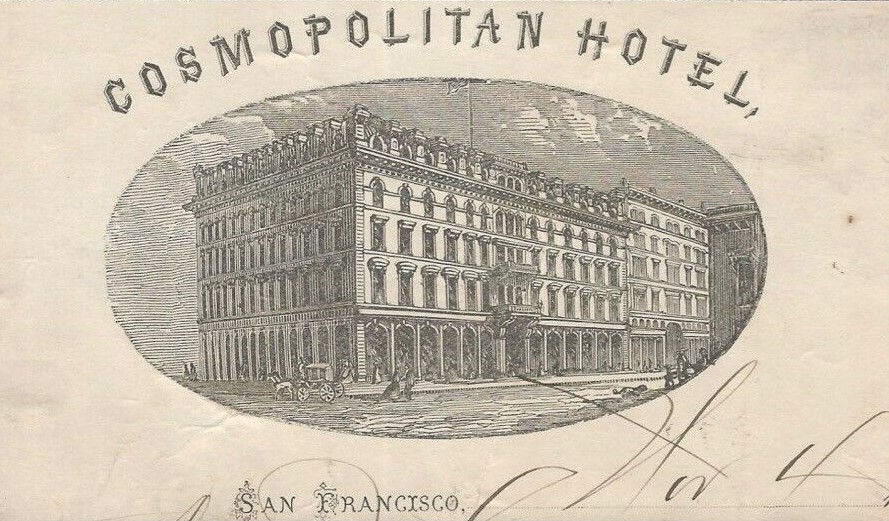
The next day, Stevenson sought her out in the hotel’s parlour, addressing her familiarly, as if he had known her for years. He met her again after lunch and invited her to the theatre. She declined.
Stevenson seemed rather displeased, saying that he had already bought the tickets. He made a rather sour sort of joke about being too poor to buy tickets and not use them, but she stood firm: she would not be going to the theatre with him.
The next morning, Stevenson met her again in the parlour, apparently on his way out of the hotel. He told her that he was going out of town, and that there were some illustrated papers in his room which she could go and collect if she wanted to read them.
A while later, Martha went to his suite for the papers. The door was ajar. She knocked and, receiving no reply, entered. As she crossed the room, Stevenson—who had been hiding behind the door—grabbed her waist “and tried to use her violently.”
They struggled, and her dress was torn as she broke free and fled the room.
Later, Stevenson went to the parlour to beg forgiveness. Martha said she was going back to her brother. Stevenson said he loved her, and would make her happy and buy her anything she wanted. He asked her to marry him. She said, “No; you are a bad, wicked man.”
She went to her room and ordered up a bath. At 10 o’clock that night, as she lay in bed, there was a knock at her door. Thinking it was the chambermaid come to take away the bathtub and bathing things, she said, “Come in.”
It was Stevenson. He stood over her and said, “It’s no use, Miss McDonald. I love you passionately.” He put his arm around her neck and pressed a handkerchief soaked in chloroform over her mouth. And then he raped her.
She left the next morning and went back to her brother in Walla Walla, where she soon realised that she was pregnant. She hid her condition from her brother, never mentioning what had happened to her, “in order to conceal my disgrace”.
After a few months, but before her pregnancy was showing, she told her brother she wanted to go home to Scotland, to live with their sister. He gave her money for her passage and she left for San Francisco, saying she would sail from there.
That may have been her ultimate intention, but she had something she wanted to do first.
When she reached San Francisco, she once again stayed in the Cosmopolitan. Of course, before long, she was again approached by Stevenson.
He shook her hand and asked how she was. She said she was very ill—almost dead. He said she looked consumptive, and she replied, “I was always a healthy girl but you have ruined me. What you have done to me lies between you and the Almighty God.”
He said he had done nothing wrong to her, that all he had done had been for her own good. She told him again he had ruined her, that she had never been the same girl since he came into her room.
Understanding her meaning, he said he knew a hospital where she could be discretely “cured”, and no one would know her trouble. She refused, but when, some days later, he offered her some “medicine that will solve the problem”, she accepted it.
The substance made her terribly ill but didn’t solve her problem—she was going to have to have the baby.
She used the last of the money her brother had given her to travel north again, going to stay with friends in Oregon. She gave birth there. The child was left on the doorstep of a convent, a brief note attached to its blanket.
When Martha had recovered—it had been a difficult birth; she had been bed-ridden for ten weeks—she borrowed some money to pay her way back to San Francisco and went directly to see Stevenson.
She gave him a newspaper cutting that contained an account of the finding of the child at the door of the convent and made sure he knew that she was destitute.
He offered her money—$40—but she threw it back, saying, “Take your dirty money!” She told him to do “what is honourable and right”: he must marry her. He refused and left town on an extended trip to Colorado, hoping that Martha would have given up by the time he returned.
She hadn’t. On his first day back, she pushed her way into his office and told him he didn’t have to hide from her. “I am a weak woman and will not harm you—if you do what is right.”
He tried several times to leave the office, but each time she knocked his hat off his head and stamped on it. She told him she had sent for a lawyer, and that they could be married at once. He hit her with his cane and ran down the stairs, shamefully bareheaded.
For the next few months, Martha drifted penniless through San Francisco, going without food for days at a time. She spoke to lawyers, judges, the chief of police. None of them would do anything, but the story she kept repeating had started to cause Stevenson some embarrassment.
He decided that something would have do be done about her.
One night in October, as Martha was leaving her rooming house in the Mission district, two men grabbed her and dragged her down an alley. They tried to tie her arms but she struggled too much. They tried to chloroform her but spilled the liquid over her head, stinging her eyes.
They pulled her on to a wooden bridge over the Mission creek. When one of the men went to fetch a carriage. Martha pushed against her remaining captor and fell back against the edge of the bridge, toppling over and falling to the water below—“all dirt and mud with dead animals”.
She called for help and people started to appear from nearby streets. The men ran off.
Martha took the story of this latest outrage to a sympathetic lawyer she had spoken to before, and he agreed to represent her. A charge of rape was brought against Stevenson, and the case came to court three months later.
It is difficult to follow the case after Martha gave her initial testimony because of the reluctance of the papers to cover it in detail—or at all, in fact.
One paper, The Examiner, wrote: “The evidence brought out yesterday was of too obscene a nature to allow its publication. As the case proceeds, the more indelicate the testimony becomes. We can turn our columns to better account than by pursuing it further.”
In the end, the jurors—one of whom was Levi Strauss, then a dry goods wholesaler five years away from patenting a design for riveted denim work pants—found Stevenson innocent of the charge.
Martha later brought a charge of kidnapping, but the judge threw it out due to lack of evidence. There is no further mention of her in any of the California papers. Perhaps she found her way to a place where she could live a good, happy life. Who knows. It happens.
Andrew Stevenson died in 1875, in his late sixties. An obituary remembered him as “a very singular character.”
Shortly after his death—perhaps only a few weeks—an Edinburgh gentleman arrived in San Francisco bearing a letter addressed to him that had been written in a flat in 32 Great Junction Street, Leith.
Stevenson’s sister, Ann Mitchell—remember Ann Mitchell? This is a story about Ann Mitchell—had learned that this man would be visiting California and had asked him to try to track down her brother, whom she had lost contact with, and deliver a letter that she had written to him.
The letter ended up in the hands of Stevenson’s executors, who were engaged in dividing up his estate among his known relatives, as he had died without a will. The following month, Ann received notification that her share would be $25,000—something like £3 million today.
Ann bought 5 Glenorchy Terrace, a large house in a new suburb for the well-off professional class in the south of the city, where she lived a presumably pleasant life for the next twenty-three years, dying in 1898 at the age of 81.
1875—Maggie Mitchell (Mrs Mitchell’s youngest daughter), who—two months before the family’s windfall—married a farmer’s son called Peter Bertram and moved to Ontario, where Peter bought an axe factory and founded the First Unitarian Church of Hamilton.
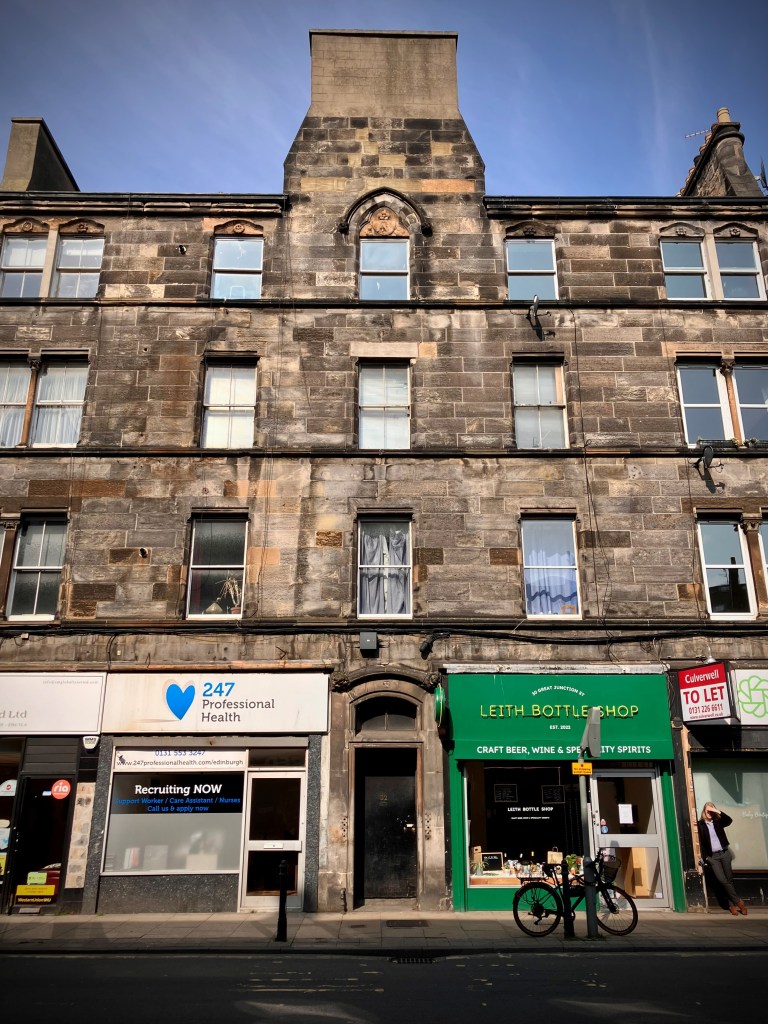
No.30—now Leith Bottle Shop—was a stationer’s in the 1890s. Every year, it became the Leith Christmas Card Saloon: “THE EXHIBITION OF CHRISTMAS CARDS IS THE LARGEST AND MOST UNIQUE EVER SHOWN IN THE TOWN OF LEITH. THE WONDERFUL ARTISTIC DESIGNS AND CHEAPNESS CANNOT BE SURPASSED.”
No.34—now 247 Professional Health—was Henry Mackie’s tailor’s shop from 1885 until he ceased trading in February 1909, when, seated behind his counter after a day’s work, he took up a knife and slit his throat. He was a widower three times over, and 69 years old.


Fascinating as ever !
Poor Margaret though .
LikeLike
Yes, a lot of sad people in this one…
LikeLike
So very interesting! Well written and well researched. Thank you.
LikeLike
Thanks!
LikeLike
Great reading it’s nice to know the history of people who moved away to make there fortune. But sad yo read the misfortune of others.
LikeLike
I’m sure there were lots of happy stories in the tenement, too, but nobody puts those in the papers, do they?
LikeLike
This has been an amazing lot of tales, some quite upsetting and one made me laugh so much with the cheapness!
THE EXHIBITION OF CHRISTMAS CARDS IS THE LARGEST AND MOST UNIQUE EVER SHOWN IN THE TOWN OF LEITH. THE WONDERFUL ARTISTIC DESIGNS AND CHEAPNESS CANNOT BE SURPASSED.”
All in all such a lot of work and really fascinating
Thanks
Jean
LikeLike
Thanks! I always like something with cheapness that cannot be surpassed.
LikeLike
You’ve outdone yourself on this one! What a great read. Also: whoops, U-boat! You think they would’ve trained them to not continue moving anywhere near a ship it just torpedoed . . .
LikeLike
I guess that occurred to the crew, too.
LikeLike
Thoroughly my enjoy reading the history on your site. My Mums parents (James and Elizabeth Wightman) lived on the top floor of number 34 North Junction Street. My Mum still remembers most of the stairs residents if she could help you.
LikeLike