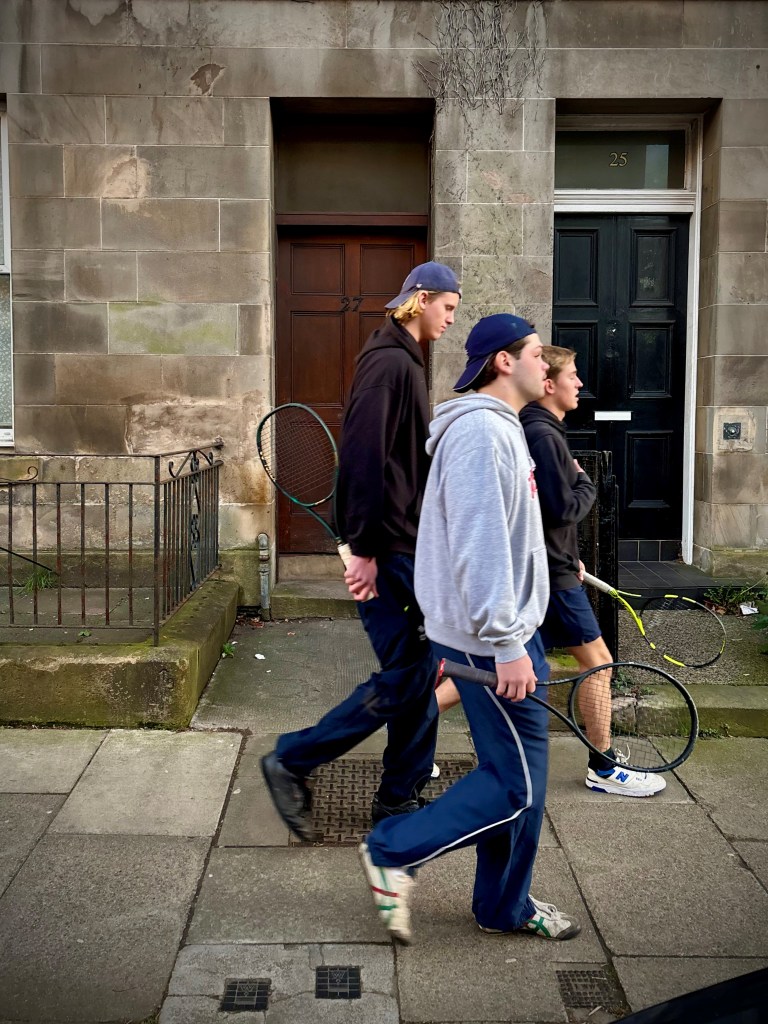
27 East Preston Street, Edinburgh. An early 1880s tenement, eight flats in the stair, over two main-door flats.
Former residents include:
1970—Jane and Lydia Sword, elderly sisters who had lived in the flat since they were in their teens, remaining there when their many siblings married and moved away. They died in a fire in their living room one spring weekend. Jane was eighty-one; Lydia eighty-five.
1969—Norman Miller, a student, who stole four cars and forged cheques using a stolen chequebook until a nine-year-old boy “with an enthusiasm for noting unusual number plates” noticed a discrepancy between the number on one car’s plate and its tax disk, and notified the police. Norman was sent to prison for nine months and disqualified from driving for three years.
1945—Isobel Francey, a fifteen-year-old bedridden girl who was rescued when a fire broke out in the flat next door to hers on the top floor while her mother was out. Isobel’s dog, Monty, refused to evacuate “and when last seen was protecting a cat also belonging to the Francey family.”
The flat where the fire broke out was badly damaged, and “a wardrobe containing a large selection of American clothes belonging to the occupier’s daughter” was destroyed. The owner of the clothes was Evelyn McNish, who had just returned from years living in the USA—see below.
1940—Evelyn McNish, fourteen years old when her parents told her that Germany was probably going to start dropping bombs on Edinburgh, so she and her younger sister Yvonne were going to be sent to America until the danger passed.
The girls’ father, an electrician, worked for the Hoover company, whose director, Herbert Hoover, had offered to evacuate the children of his British employees to the neutral United States. More than 100 children were signed up and set sail on the Cunard cruise ship Samaria.
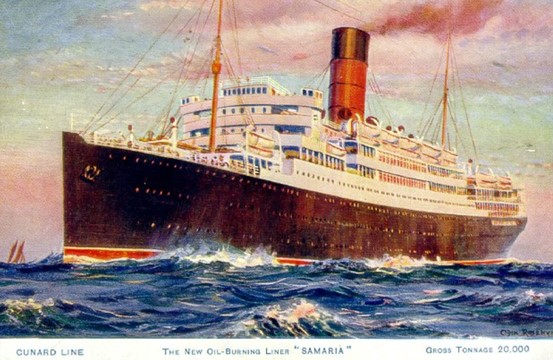
The Hoover evacuees landed in New York in August. (The following month, a liner carrying a hundred children to Canada was sunk by a German U-boat. Only nineteen survived, and the programme of evacuation by sea was abandoned.) After experiencing the wonders of New York—chewing gum, ice in soft drinks, showers—the children were put on a train to Canton, Ohio, the base of the Hoover company, where families were waiting to take them in.
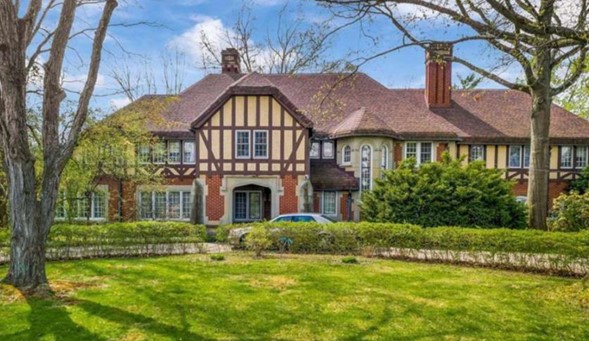
Evelyn and Yvonne—popular children who had won beauty and talent competitions on the boat, and had entertained the passengers with Scottish songs—were matched with the family of Dan Hoover, one of the Hoover heirs, who lived in a Tudor-style mansion. This one, I think:
Nobody knew how long the children would have to stay. Evelyn enrolled in North Canton high school and was mentioned in a Life magazine article about the British Hoover evacuees—“There was Evelyn McNish, learning to jitterbug”.
The war dragged on, and Evelyn graduated high school, where she had played the title role in the school’s production of “Mrs Miniver”, and was accepted by accepted by Wittenberg University, Springfield, Ohio, where she played Ellen Turner in the dramatic society’s production of “The Male Animal” and made the honor list for academic excellence.
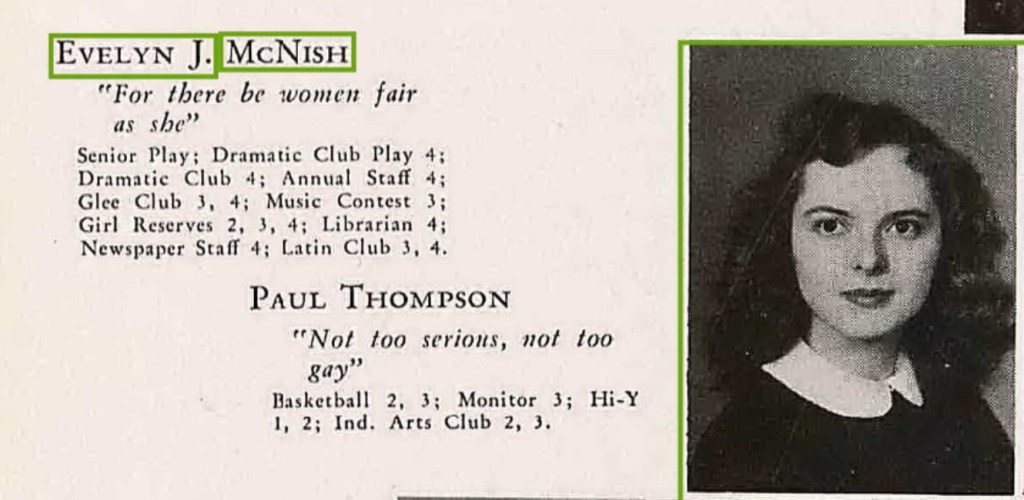
(My thanks to Fergus Smith, genealogical researcher (oldscottish.com) for the above yearbook clipping.)
When the war eventually ended, she and Yvonne returned to East Preston Street—Evelyn quite reluctantly. The following year, she entered a Butlin’s “Holiday Princess” beauty competition, with the aim of winning a trip to the USA, but came third in the local heats.
She made it back to America before long, though, emigrating just after she married a salesman from Cheltenham, Laurence Home. They raised a family in Tampa, Florida, where Evelyn worked in admin in the general hospital until she retired. She died in Alabama in 2014, aged eighty-eight.
1940—Yvonne McNish, who was six when she started school in Canton and eleven when the war ended and she next saw Edinburgh and her parents.
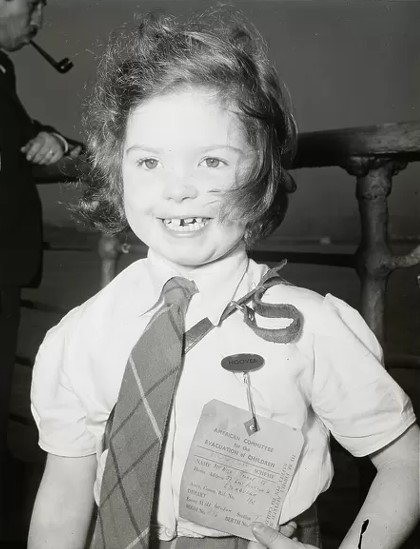
When she was twenty-two, she married Mauro Cecchini, another Edinburgh native who had spent the war elsewhere—he had been on holiday in his parents’ home town in Tuscany when the war broke out, and had been unable to come home.
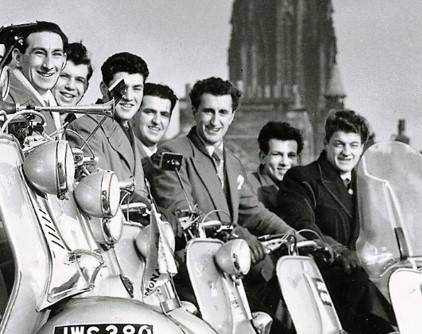
The picture below, of the Italian Vespa Club of Edinburgh, shows Mauro (third from right) around the time he met Yvonne, before he went on to become a chip shop owner, restaurateur and eventually proprietor of the Mayfield House Hotel in Musselburgh.
Yvonne died in 2014, aged eighty. Mauro died in 2022, aged eighty-eight.
1925—Douglas Anderson, a twenty-year-old electrician, who was found by his brother one morning with his head in their gas oven. “A doctor who was called found life extinct.”
1922—Robert Sword, the youngest brother of the sisters who would die in a fire in the tenement almost fifty years later, who, at the age of twenty-four, stole eleven books from the publisher’s offices where he worked, for which he was fined £2.
1913—Margaret Sword, an older sister of those same Sword sisters. She died of pneumonia in the flat at the age of thirty, seven years after she moved there with her mother and six siblings following the death of their father, also of pneumonia.
1900—James Dobbie, who was playing near the edge of Salisbury crags when he lost his footing and fell over, fracturing his skull “sustaining such serious injuries as to necessitate his removal to the Royal Infirmary”.
1899—Kate Burness, thirteen, the eldest daughter of James Burness, a commercial traveller. She “was sliding on the stair rail when she slipped over and fell a distance of 32 feet”, dying shortly after. James died of tuberculosis a few months later.
1899—Madge Burness, a four-year-old girl who died of tuberculosis. The sister of Kate, who would fall from the stair rail seven months later.
1898—James Burness, who died, “apparently of a spasm of the windpipe”, at the age of seven months. Little brother of Kate and Madge, who died the following year.
Their mother, Janet, who, by the end of 1900, had lost her husband and three children and was left with four children to support on her own, made ends meet by letting out one of the rooms in the flat. Her surviving daughters all eventually emigrated to the colonies, marrying and raising families in South Africa and New Zealand. Janet may have gone with one of them; there is no further record of her life or death in Scotland.
1894—Alexander Henry Murray, a sixty-eight-year-old hat manufacturer, who died of a heart attack in an omnibus at Angle Park Terrace about one o’clock on a Wednesday afternoon.
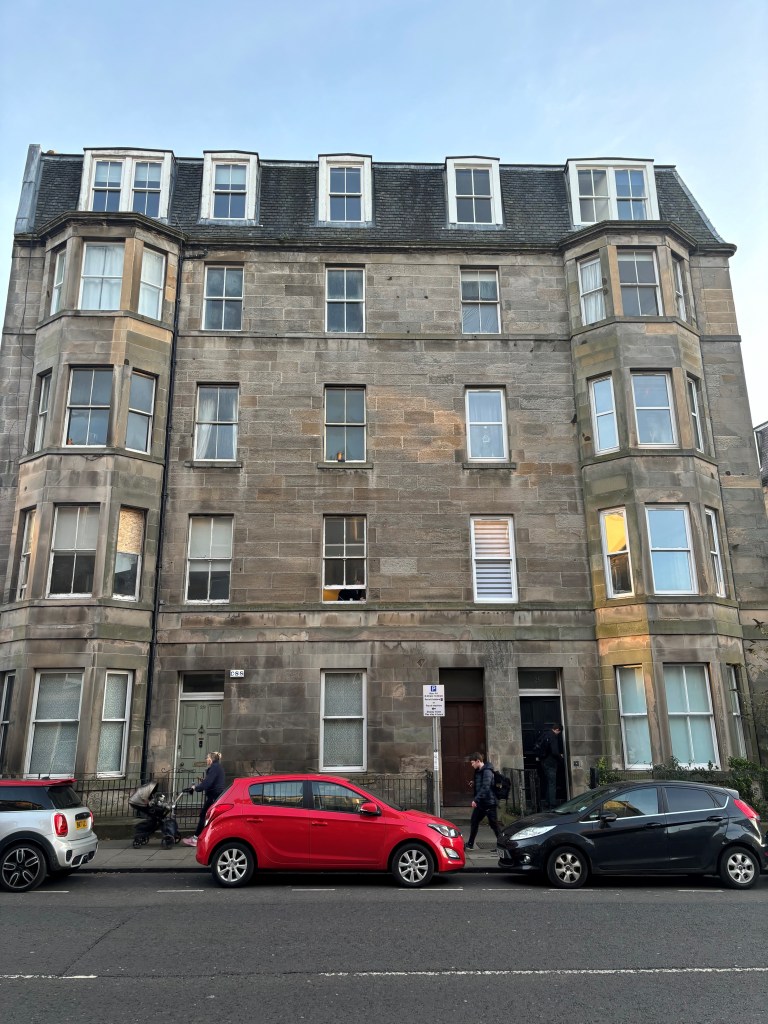
The tenement was built decades later than most of the others on the street, on the front green of Robertson’s Academy, an ailing private school that sold off the land in an attempt to stay afloat but was soon demolished to make way for the tenements of South Oxford Street.
 Tenement Town
Rather an unlucky stair with all the deaths and fires..
LikeLike
A huge thank you for taking time to put these pieces together. I really enjoy reading them, so many fascinating lives in one building. Looking forward to 73 Rankeillor Street where I lived in the 90s.
thanks again.
LikeLiked by 1 person
The electrician, who died by gas…!
I used to know a young woman on South Oxford Street.
LikeLiked by 1 person
Fascinating but what a sad tenement this has been. And Im sure most others in Edinburgh had similar tales to tell. Karen
LikeLiked by 1 person
Fascinating stories. Thank you for doing all the research and sharing.
LikeLike