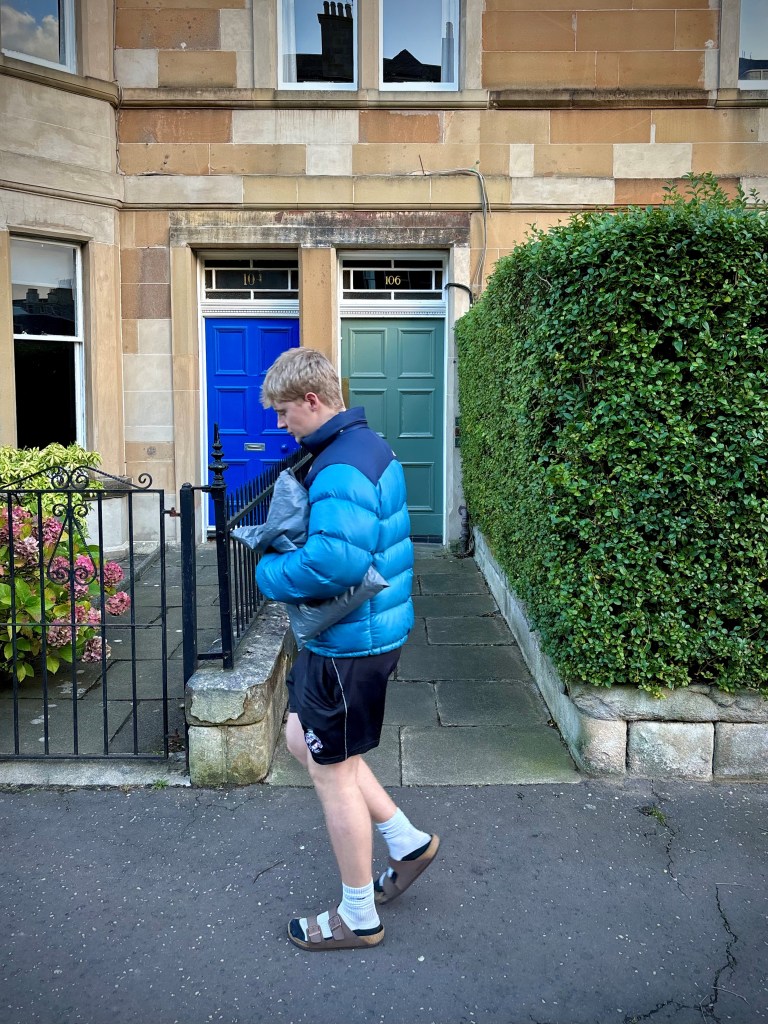
106 Spottiswoode Street, Edinburgh—built around 1905, with six flats in the stair above two main-doors. Former residents include:
2009—Hillary McCallum, an artist, photographer, poet and teacher who left her second-floor flat in the tenement for a nursing home after living there for most of her adult life, following an initial spell in London in the early 1950s, where her husband, Keith, was a senior civil servant in the Scottish Office.
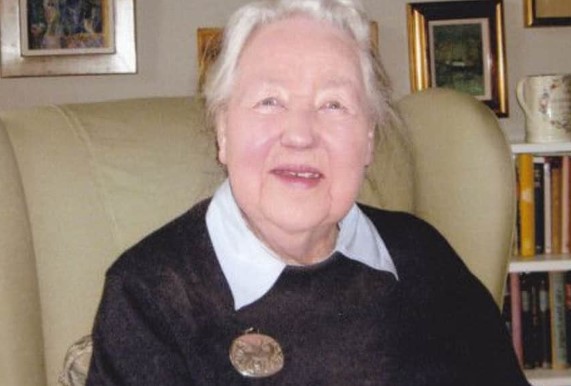
Hillary and Keith “shared a passion for Scottish artists”, counting many as personal friends, although Hillary “was more outgoing than Keith, who was somewhat reserved”. Keith’s reserve may have masked his depression, which worsened in the early 60s. In September 1964, in a field outside Carlops, south of Edinburgh, he took an overdose of barbiturates in the form of the bright blue bullet-shaped capsules known as blue heavens. He was forty years old.
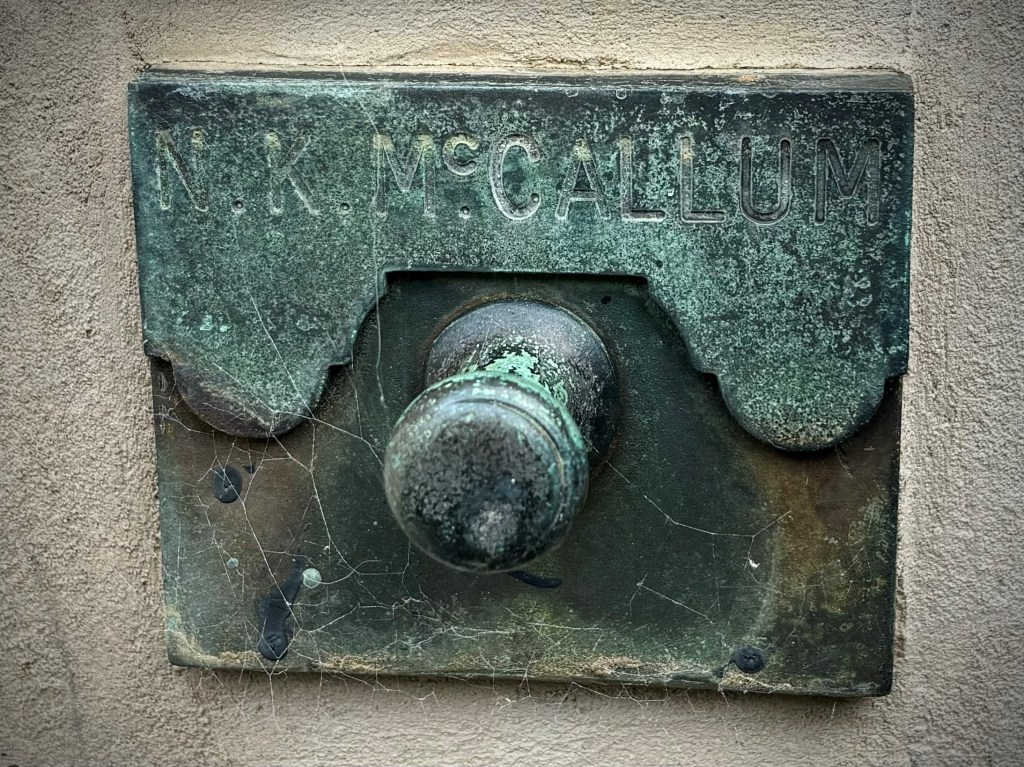
Hillary remained in the flat, an energetic character with a wide circle of friends. She died in 2014, remembered for her qualities of “decency, kindness, and generosity” and “her rigorous and sometimes fearsome intellect.” On the flat’s old bell pull at the tenement door, Keith’s name remains.
1946—Bradford Falconer, a sales manager whose grandfather ran a bookbinding business in St Cecilia’s Hall in the 19th century. The firm supplied exercise books to the Royal High School, where Bradford was educated, so he was able to get his books for free, providing he braved the Cowgate.
Closing the letter informing readers of The Scotsman of this fragment of personal history, Bradford wrote: “This is probably not very interesting to many people, but I thought I would let you know.”
1930—Thomas and Margaret Waterston, who celebrated their golden wedding anniversary with a dinner in the Dundas Rooms in the New Town in the company of a hundred guests, including the board of Hearts FC, of which Thomas was a director.
Born in 1860, Thomas had “an adventurous career as a youth at sea” before becoming a dairy inspector with the Corporation’s public health department and, in 1880, marrying Margaret McBeath, the daughter of a chimney sweep, and raising a family in the Spottiswoode Road flat.
In 1944, when Margaret was eighty-two and Thomas eighty-four, a dropped cigarette set their bedclothes on fire, and they had to be rescued from their flat by the fire brigade. Margaret was taken to the infirmary, where she died that night. The doctor recorded the cause of death as “Apparently senility”.
Thomas lived alone in the flat for four more years, until he was killed by a cerebral haemorrhage one January afternoon.
1944—Robert Lindsay, a widowed and retired law agent, who, at the age of eighty-two, suffering from cancer of the bladder, killed himself with gas from his oven. He had spent the early years of the war, whose end he never saw, writing patriotic verse, such as this one, published in The Montrose Review in 1940:

1938—James Kerr, who was “one of the best-known figures in the tobacco trade in Edinburgh”. Employed by John Sinclair Ltd for thirty years, he “was responsible for bringing out one of the firm’s best-known blends of tobacco” and died at home of a heart attack, aged sixty-seven.
1912—Hamilton Hoyland, a medical student from Suffolk who, in March, married a twenty-two year old woman called Muriel Miller.
The previous October, Muriel had met a teacher from Liverpool, Thomas Deakin, on a train to Edinburgh and married him there two weeks later. After “living as husband and wife” for a weekend in a hotel in Carlisle, they returned to Edinburgh, going from the station directly to the house of a friend who broke the shocking news that, as neither of them had lived in Scotland for the required twenty-one days prior to the marriage, their union was illegal. They checked with the relevant authorities and discovered this to be true.
A judge nullified the marriage a few months later, just in time for Muriel to marry Hamilton Hoyland, whom she had met in the interim.
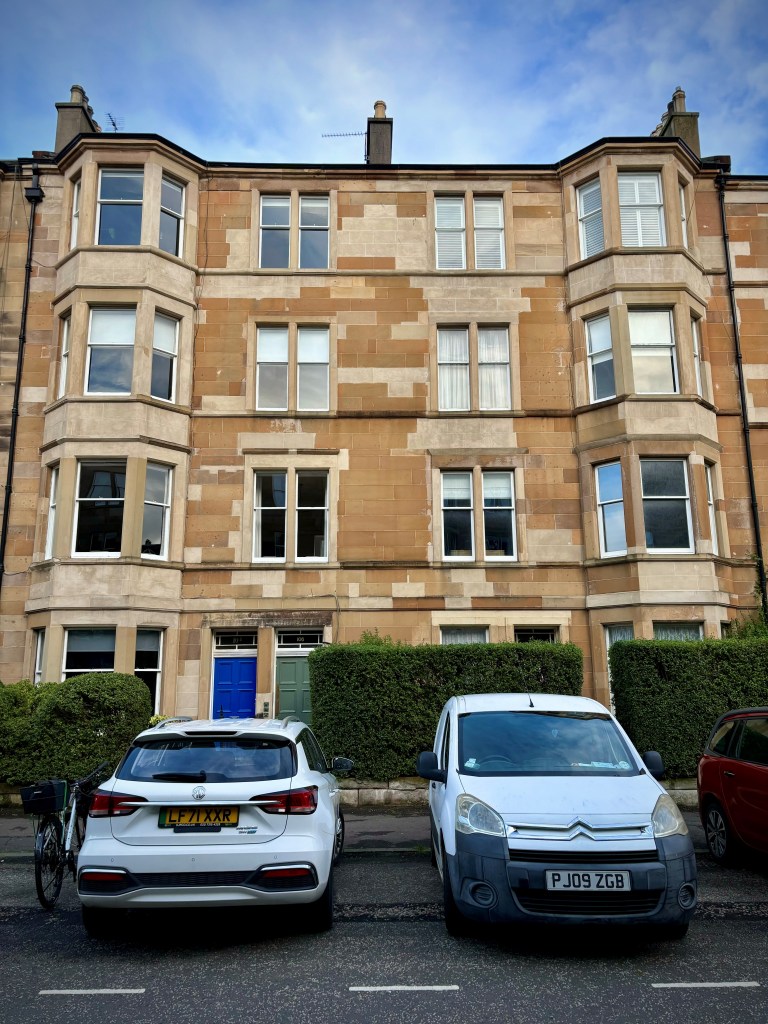
Number 104—the ground-floor-left flat—was home, in the 1940s, to Charles Ewart, a bank clerk from Caithness, who ran the John O’Groats Society, which supported citizens of the far north of Scotland who found themselves in Edinburgh, particularly those who were being treated in the Royal Infirmary, far from their families.
In 1950, at the age of fifty, Charles became engaged to maternity ward sister Catherine Anderson (known to untold numbers of grateful mothers as “Andy”), but died of a heart attack before the wedding. Catherine also died of a heart attack, ten years later, just after she retired.
Number 108—ground-floor-right—belonged at the beginning of the 20th century to Arthur and Agnes Thom, whose son George emigrated to South Africa. At the outbreak of the great war, he joined the South African Infantry and was sent to France, where he was grievously wounded at Ypres and died in a hospital in Boulogne, aged thirty-eight.
Arthur and Agnes’s grandson Arthur—George’s nephew—joined the South African Motorcycle Corps and was sent to German East Africa, where he contracted malaria. He died in a hospital in Pretoria, a week before the end of the war, aged twenty-one.
Arthur and Agnes’s daughters, Elizabeth and Margaret, inherited the flat upon the death of their parents and continued to live there until their hearts wore out in old age—Margaret, the last survivor, dying in 1958.
Finally, there is a former resident of the stair who I know personally: my old friend Gavin Francis, who lived there as a medical student in the 1990s (and became a friend of Hilary McCallum in her later years).
Gavin, now a writer as well as a GP, has recently published a new book, which talks about the idea of bridges through history, geopolitics, psychology and literature, and is less depressing than Tenement Town. Recommended.
 Tenement Town
Very good as always, but a wee bit depressing this time.
I do enjoy these however, good research.
LikeLike
Fascinating as always. So many tragedies in these tenements. But some splendid name; Bradford Falconer and Hamilton Hoyland !
LikeLike
I find these stories very very interesting and not at all depressing.
Lang may yer lum reek.
LikeLike
Hi Diarmid,
Thank you for doing this research. I find it interesting to learn who has lived in places. There are quite a few people in today’s post, so over the years, there are going to be people who die. You are giving us the facts.
Hi to Gavin! I wish him well, and that he realizes how much we need him today!
Take care, I look forward to more research! It takes me back to living in Edinburgh, which I loved! Ellen
LikeLiked by 1 person
Tenement Town is not depressing: ‘all human life is there’. And the woman with the young lion! Who can top that?
LikeLike
I don’t know—even I find it quite depressing sometimes. I try to find uplifting stories, but you have to work with what you get!
LikeLike
I love your research; so interesting.
LikeLiked by 1 person