
12 Meadow Place—built in 1877 on the easternmost corner of Bruntsfield Links; eight flats, all entered through the close.
Former residents include:
1970—Mary Crow, a retired typesetter who moved into the tenement with her parents around the end of the 19th century. She never married, and outlived the rest of her family, dying in her flat at the age of eighty-two.
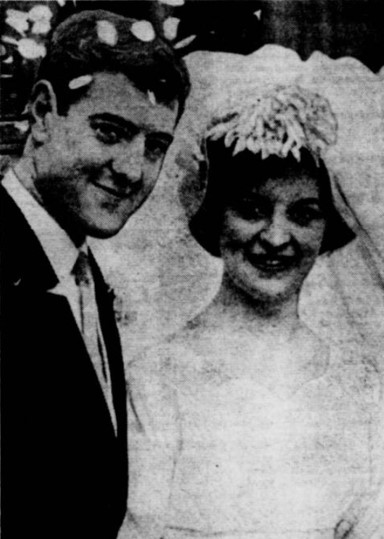
1963—Maureen Ross, who married Robert Grant, a football player from Tranent who was playing for Leyton Orient at the time. The Daily Record, noting in passing that Maureen was “pretty”, published their wedding photograph with the caption, “The Happy Footballer.”
1948—Alma Woudberg, of Cape Town, the wife of a doctor, Manzie Brydone Woudberg, who was spending a few years working in British hospitals in the hopes of returning home with sufficient skills to set himself up as a gynaecologist. Alma lived briefly in the tenement during the second Edinburgh Festival, “staying with a friend who invited me to share her home after meeting me only twice.”
She was impressed with Edinburgh, especially the way “the huge stone castle” loomed over the theatres—“After leaving the Usher Hall, you come out on a fairy scene. It is almost as though this city were built in a setting fit for plays and the music of the great.”
She returned to her husband full of news of the wonders of the city. She said, “I’m sure Edinburgh will have to enlarge all halls and theatres, as next year’s Festival will surely bring thousands more visitors.”
And so it came to pass.
Manzie’s plan to become a gynaecologist ultimately failed, and he contented himself with a general practice in a small town serving the Orange Free State’s gold and uranium mines. He died in 1971, and Alma died twenty years later, aged seventy-four.
1943—Georgina Vance, whose family moved into the building from their Leith Walk flat when her father’s brass foundry in the Grassmarket started bringing in money. Georgina got a job teaching at Nelson’s College, a vocational school in Charlotte Square. The school’s adverts ran: “For many years, NELSON’S COLLEGE has been the Guide and Friend of Young People who are on the threshold of their careers. Thousands of SUCCESSFUL MEN and WOMEN in all walks of life owe, in no small measure, their SUCCESS to their EARLY NELSON TRAINING.”
Like Mary Crow, the retired typesetter at the start of this piece, she ever married, and outlived her family, dying in the flat in 1943, of a stroke, at the age of seventy-five.
1902—Jane Houston, who, in 1897, met a medical student from Trinidad, Berrington Ghose—like Jane, around nineteen or twenty years old—whose father was a court interpreter in Port-of-Spain and whose mother, Marie Montrichard, was a descendant of French nobility.
A little over a year later, Jane discovered she was pregnant, and she and Berrington decided to marry.
Berrington wanted to wait until after his second examination—the end of his pre-clinical years of study—before they formally married, but Scots law provided (at that time) another permissible, if irregular, option: marriage by declaration, which involved a couple simply declaring in a public place that they were taking each other as husband and wife.
Jane agreed to the arrangement—it was better than nothing—and to it being done in Glasgow, to keep it as quiet as possible. Accordingly, in one of the public rooms of a temperance hotel by Glasgow Central Station, Berrington put a wedding ring on Jane’s finger and said, “I take you for my wife” and she replied, “I take you for my husband.” The ring was inscribed “B to J. Ever true. February 1899.”
Their child, Iris Agnes Ghose, was born in August 1899 and registered as illegitimate. Jane sent the baby to a family in Balerno and got a job as a housekeeper. Berrington told no one, not even his close friend, a fellow student with whom he had travelled from Trinidad.
The couple lived in separate flats, seeing each other when they could and writing letters frequently, Berrington constantly reassuring Jane that, although propriety kept them apart, their marriage was real and true. He wrote: “For love’s sweet sake we must be to each other all in all. That I love you sincerely and fondly you know too well.” And: “My darling wife. I have your face before me, looking as you did on your wedding day. Au revoir—Your loving husband.”
Jane prepared herself to convert to Catholicism, Berrington’s religion, so they could eventually be formally married by a priest but, in early 1900, Berrington was struck by terrible abdominal pains, which turned out to be intestinal tuberculosis. He died in May, aged twenty-two.
Berrington’s family learned of baby Iris’s existence—Jane presumably told them—and proposed to assume custody of the child and take her back to Trinidad, something that Jane learned was made possible by the fact that she and Berrington had not registered their informal marriage.
Jane had to go to court and ask to be declared Berrington’s widow. The judge said he could not understand why Berrington had not put something in writing, but said he was satisfied, on the basis of the letters and other evidence, that the marriage was genuine. Berrington’s family were forced to accept that they had no claim on Iris, and what The Scotsman described as “the rather pathetic story of an Edinburgh student’s affaire d’amour” came to an end.
Jane subsequently moved to England, married twice and died sometime before 1936, when Iris married a cemetery worker from Bridge of Weir named Robertson Cameron. Robertson died in 1964, aged sixty-one; Iris died in 1975, aged seventy-six.
1898—William Somerville, a mason, who chiselled sandstone for decades, inhaling clouds of fine silica dust that, by the time he was forty-eight, stiffened his lungs with scar tissue, making breathing painful and, finally, impossible.
1883—Fanny Pottie, a lady’s maid who lived with her mother until her mother died of an asthma attack, aged seventy-six
Like Mary Crow, the retired typesetter from the start of this piece, and Georgina Vance, also above, Fanny never married, and outlived the rest of her family. She died in 1926, aged 82, the same age Mary Crow would be when she died in the tenement in 1970.
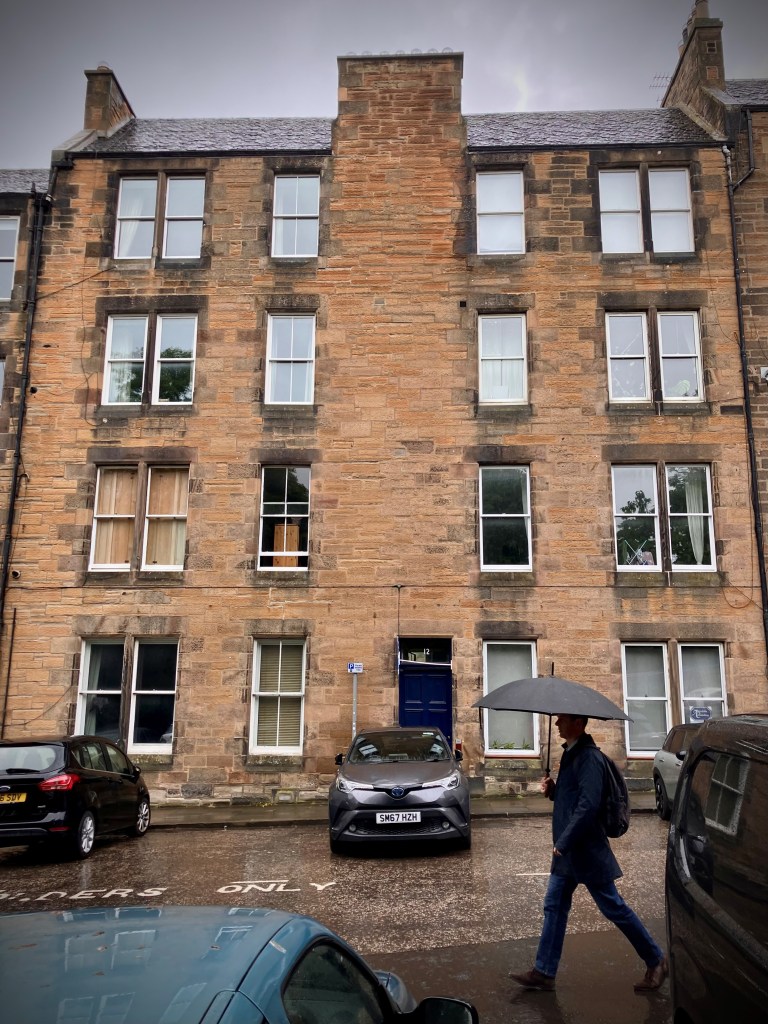
The block of which the tenement forms a part was built on the site of a venerable building known as the old golf house, which was the original 17th-century clubhouse for Bruntsfield Links golfers. The front door of number 12 is where the ‘G’ of Golf is in the coloured map below, from 1822.

In 1815, A Mr Scott bet a Mr McDowall a guinea that he could drive a golf ball from the old golf house over Arthur’s Seat in 45 strokes. He lost the bet. Later that day, a Mr Brown made the same bet with a Mr Spalding and won, completing the feat in 44 strokes.
 Tenement Town
That was some golfing.
LikeLiked by 1 person
as always very interesting, a thoroughly enjoyable read.
LikeLiked by 1 person