
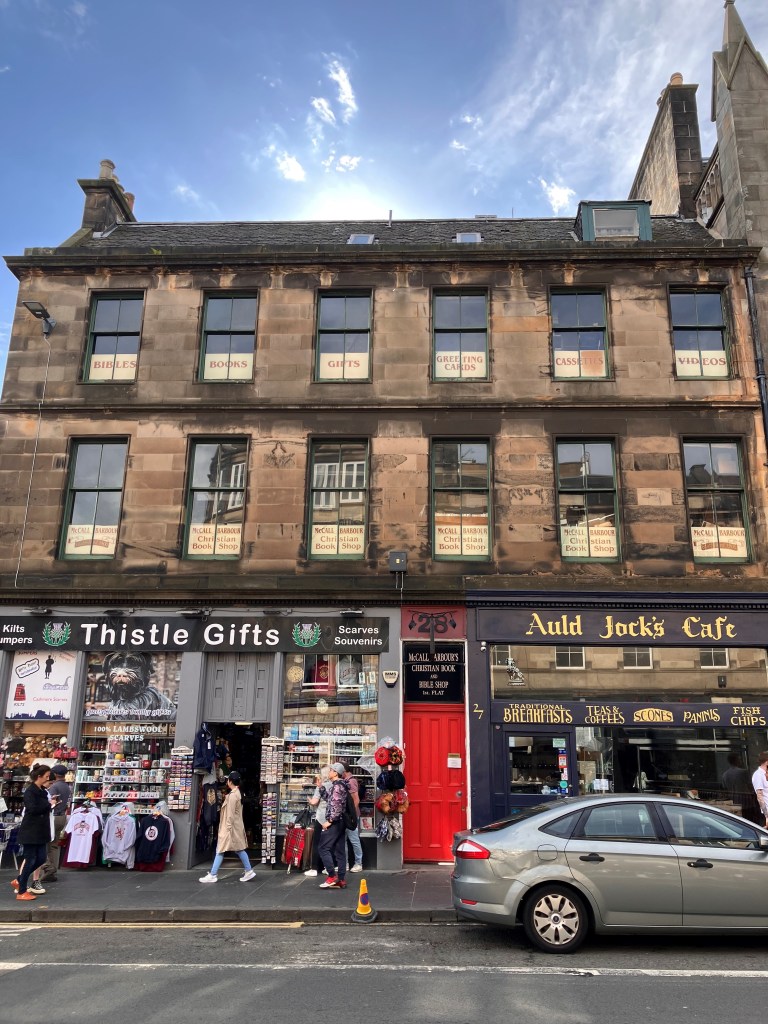
28 George IV Bridge, Edinburgh, built in 1859 at the same time as its neighbour, the Martyr’s Reformed Presbyterian church (now the Frankenstein pub), probably as a source of feuing income for the church’s maintenance.
Former residents include:
1936—Benjamin McCall Barbour, who opened a Christian bookshop in the first-floor flat, after living for some years in the flat upstairs.

Born in 1865, the son of a butler, he lost a brother in a railway accident when he was one and a sister to peritonitis when he was ten. By his twenties, he owned a stationery shop in Nicolson Street, which made great use of the city’s workforce of telegram boys.
Concerned about the moral welfare of these young men, he established a mission hall for them in the basement of his shop—a place removed from the temptations of the streets where they spent their working days, and where they could be exposed to Christian teaching.
He made a name for himself writing for boys’ and women’s magazines, producing morally improving but only mildly religious articles, such as his series for The Family Friend about mothers around the world (written entirely without the benefit of travel furth of Scotland).
When he was thirty, he announced that he had been called by God to become a missionary. He sold his business and paid for himself and seven of the telegram boys to go to Bible college in America. After six months, however, he revealed that God had told him to return to Scotland.
He secured passage on a boat for home, leaving the boys to their studies. (They evidently finished their training and are recorded as going on to proclaim the Gospel in various parts of the world.)
After moving back in with his mother, Benjamin set up a new organisation for the salvation of Edinburgh’s youths—the Boys’ Purity Band, which met in a hall in a Chambers Street tenement.

At the same time, he started teaching the Bible and publishing his evangelical pamphlets, initially aimed mainly at young boys. A reviewer said they were “healthy cheap booklets, a splendid antidote to the ‘bloody-nosed, wheel-barrow’ rubbish which is so prevalent”, imparting lessons that, if followed, would “augur well for the future manhood of our Empire.”
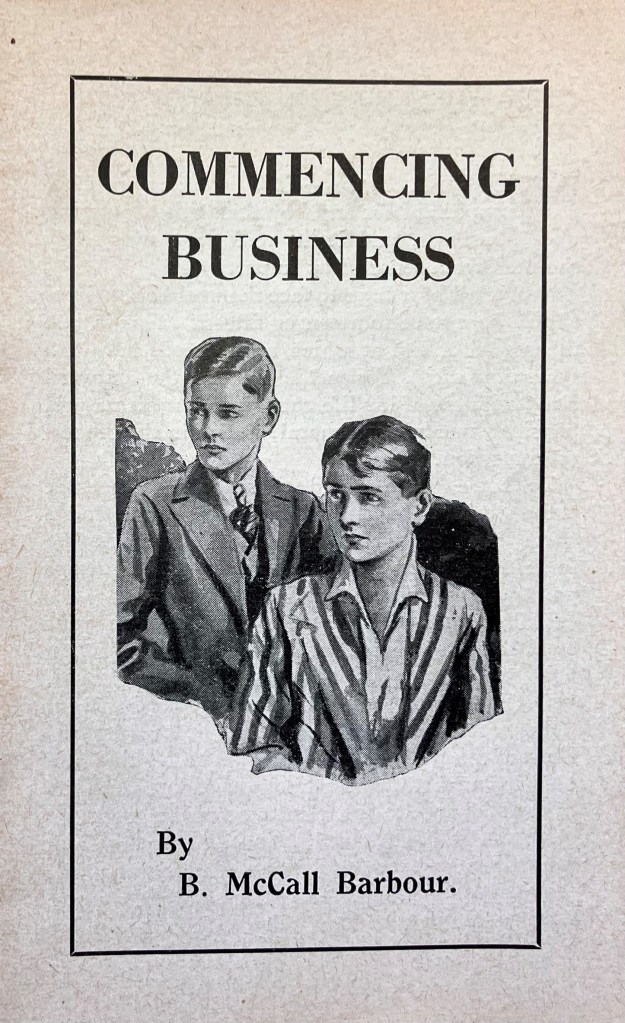
They sold well, and the business grew.
By the 1930s—when he opened his shop in the flat below the flat on George IV Bridge where he was by that time living—Benjamin, assisted by his friend, James Danson-Smith, an engineer turned Christian poet, was publishing hundreds of books, leaflets and verse cards every year.
Benjamin died in 1943, of a heart attack, at the age of seventy-eight. If he had time to realise what was happening, he would have been overcome with joy, if the sentiment of one of the verses attributed to him is any guide to his true feelings:
“Today? Perhaps! Tis true! Today!
Ere nightfall we may be away;
Transported home! How blest, how grand!
Transported home to gloryland!
One twinkling moment, then to be
With Him for all eternity.”
Benjamin left everything to Danson-Smith, who, in turn, left everything to his children, Theo and Grace, who ran the shop through its busiest decades—the 60s and 70s—and hoped to do so until Jesus returned, sometime in their mortal days. “Perhaps today! He’ll come most sure!”
Theo died in 2018; Grace, in her nineties, abides.
1903—James Carson, an insurance collector from County Armagh who moved to Edinburgh and, in 1893, married Williamina Ross, from Castletown, near Thurso on the north coast of Scotland. Two children were born of the marriage, “which was from the first a failure.”
James said the chief cause of the unhappiness was Williamina’s repeated absences from home for weeks and months at a time. Williamina said the problem was James’s drinking, and the fact that he had sired a child with a Miss Paterson of Warrender Park Road.
James, in return, said that Williamina had been carrying on with a man on her trips north to see her family, and that, “when I spoke to her about it, she made my life miserable.” Things got worse in 1900, when she took in two female lodgers, with whom she “drank and carried on.”
One day in July 1901, after much discord in the household—dishes thrown by her; punches by him—James returned home to find removal men carrying the household’s furniture out into the street.
Williamina was supervising the work from her solicitor’s window, which was in the building opposite. James got a policeman to stop the removal, but “all the best furniture” had already been taken away to be sold and was never returned to him. She took the children and went north.
Williamina had returned to the city by the autumn of 1902, when James saw her and a man walking arm in arm down Ardmillan Terrace in deep conversation. He followed and saw them enter a field near the railway bridge at Slateford, where he watched them “misconduct themselves”.
He began shouting, quickly gathering a crowd of 40 or 50 people, whose testimony was later used in court when James sought a divorce. Williamina retaliated by trying to divorce James first, but there was no one to corroborate her claim about Miss Paterson of Warrender Park Road.
The judge said that, “as to credibility, there is not much to choose between the two,” but ultimately found in James’s favour, granting him the divorce, and custody of the male child. The man from the field in Slateford—a Mr Cumming—was ordered to pay the expenses.
Williamina and her daughter left Edinburgh for good, returning to her family in Castletown, where she told everyone that her husband had died. She did not remarry, and died of heart failure there in 1952, at the age of eighty-five.
James eventually became a tram conductor, living alone in a flat in Hanover Street. He suffered badly from bronchitis for years, and died in 1933, aged sixty-eight, a few years after he retired.
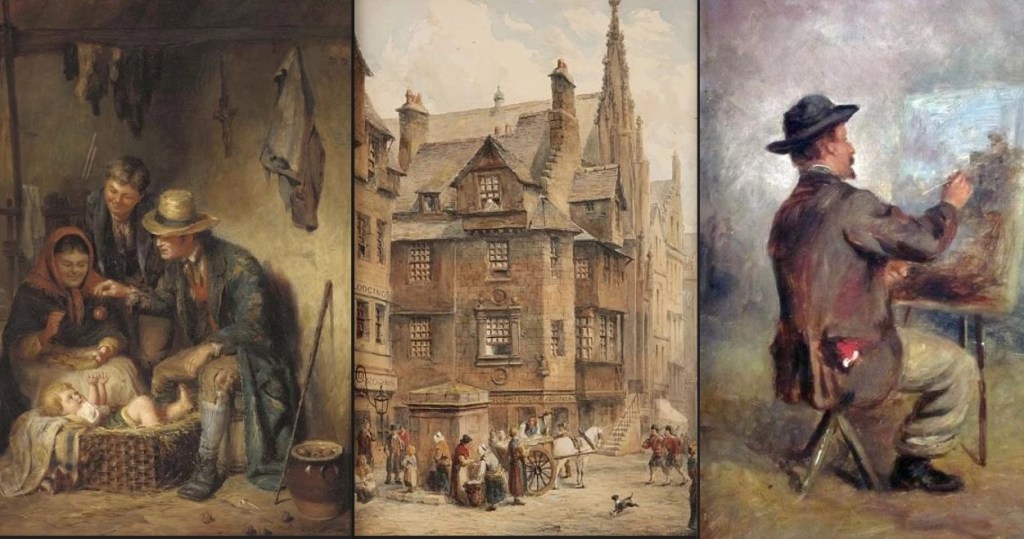
861—Robert Sanderson, a moderately successful but technically unremarkable and consequently long-neglected painter of Scottish subjects in oils and watercolours. (The third picture below appears to be a self portrait.)
Robert moved into the stair after he married Sarah Jacob, the daughter of Moses Jacob, a “well-known Hebrew” who lived and worked in the building next door. Moses, born in Lithuania, was one of the first feuars of George IV Bridge, in the 1840s, building a property at a cost of £1,000 that faced both Candlemaker Row and George IV Bridge and was known (by him, at least) as “the House of Jacob”.

The top floor was the family home, while the middle floor, on the pavement level of George IV Bridge, functioned as Moses’s shop, where he sold antiques, books, second-hand furniture and other goods. On the bottom floor, opening on to Candlemaker Row, Moses ran a public house.

Moses had made his money over many years of travelling around the north of Scotland, buying and selling items of any and every description at auctions and fairs. A visitor to the Lammas fair in Kirkwall in 1844 wrote: “Moses—who is a genuine descendant of the Jewish race and had a most extraordinary look—dealt in everything. A horse bridle, a bread basket, scissors, a bottle of ink, were brought out repeatedly as ‘positively the last vone’ and were ‘sould and sould again’.”
The following Lammas, Moses was in St Andrews, where another writer observed, “He disposed of a great many superfine ready-made vests for 18 pence-a-piece, while each successive one he warranted to be a finer one, a stouter one, a better-sewed one than the last.”
Moses’s shop was a repository of the vast collection of motley items he collected on his travels. It was “the most miscellaneous of its kind in this or any other city”, containing “everything, from a needle to an anchor”. One visitor wrote: “A tattered psalm-book or a thumbed song-book, a Bible or the Newgate Calendar, a gold chain or an iron cable, a chest of drawers or a second-hand coffin—all were there for sale at reasonable prices.”
In the early years of his occupancy of the building, Moses was subjected to verbal and physical abuse from “certain unprincipled abandoned boys”. He complained to the council in a letter that The Caledonian Mercury described as “a comical petition from an eccentric Jew”.
He wrote that some “half boys, half men” insulted him on account of his religion “in the foulest and most opprobrious language, too low and vulgar to repeat”, and had thrown stones into his shop and his flat, one of which had severely injured his wife.
The police, he said, did nothing but reprimand them. He pointed out that “such immoral and cruel conduct is not allowed in London nor in any other place in the British dominions towards the Jew subjects, who are a quiet, industrious, inoffensive people.”
He concluded by asking the council to do something to “accelerate a better feeling in the minds of the lads of Edinburgh towards the persecuted children of Israel, whose ancestors wrote by inspiration the Holy Bible, the proper rule of faith for all mankind”.
The council members expressed some sympathy, one bailie suggesting that the young men of Edinburgh were generally of a more depraved and cruel disposition than those of elsewhere, and passed the petition to the police, who may have done something. Or not.
Moses never stopped travelling around the Highlands selling goods and searching for bargains at auction, even towards the end of his life, when his health failed and he was experiencing great pain from what turned out to be cancer of the jaw.
In the spring of 1865, he told friends in Caithness, “I’ve consulted the faculty in Wick and the faculty in Edinburgh, and they can do nothing for me, so I think I’ll just go home and die.”
In March, as Moses lay in bed upstairs, his family closed the shop, which had deteriorated in recent years into a repository of largely rusting and broken junk, and began to “disperse the rubbish which for years had lain mouldering in the open but apparently unfrequented premises”.
Three weeks later, he died in his bed, at the age of sixty-five.
For a short while, Robert Sanderson moved his artist’s studio into the shop, but it was soon sold and spent the early part of the next century as John Grant’s bookshop and the latter part as Pizza Paradise.
Robert and Sarah moved around the corner to a flat in Forrest Road, where they stayed for the rest of their lives—Sarah dying in 1911 and Robert in 1918.
 Tenement Town
Ooh, which stair in Forrest Road? I/we lived at 59 for a while.
LikeLike
Ah, too bad — they were in number 6!
LikeLike
I’ve never come across the word, “furth” before. Thanks!
LikeLike
Always educational, this site.
LikeLike
Two Caithness connections in this building! I grew up there so it’s always nice to see a mention 🙂
LikeLiked by 1 person
I got my first paid job from Theo and Grace, courtesy of my mum who was their secretary. Saturday mornings only, the work was general tidying up but I mainly remember being tasked to polish the brass nameplate at the street door.
LikeLiked by 1 person