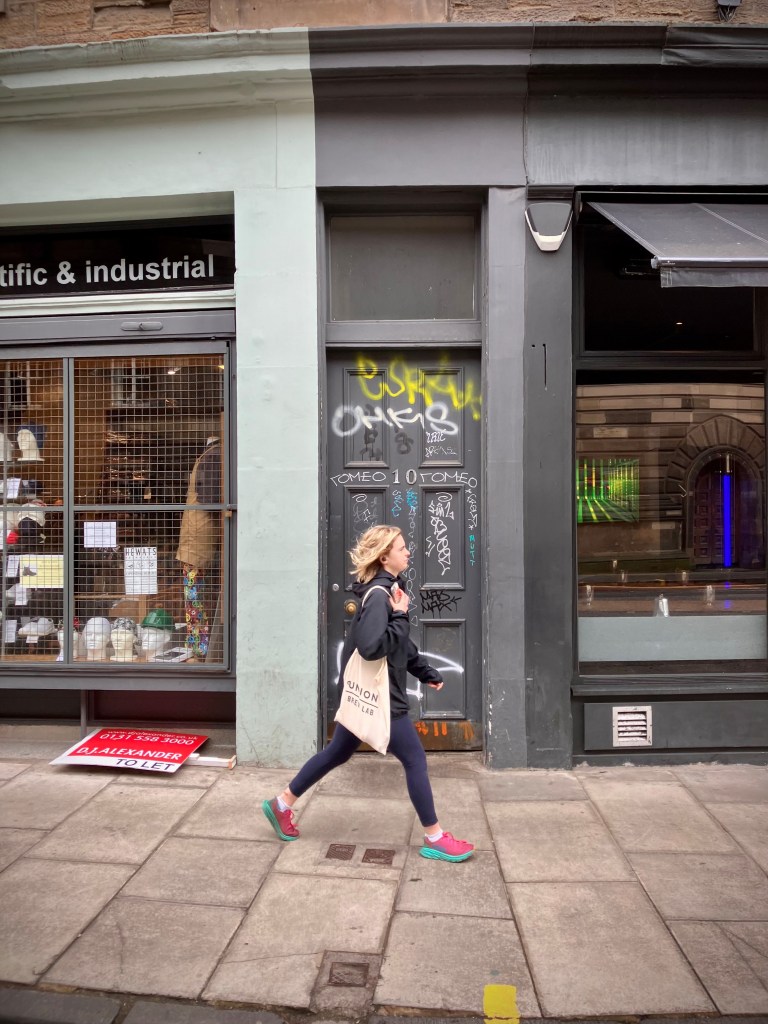
10 Teviot Place, Edinburgh—a late 19th-century tenement in the Scots baronial style, with six flats over two shops. Former residents include:
1954—Josephine Bell, whose Swiss father, Adolphe Bachle, ran a tobacconist’s in Portobello in the 19th century before taking over the Maitland hotel in Shandwick Place, going bankrupt within a year and eventually dying in a Hertfordshire workhouse for destitute Germans and other foreigners.
In 1902, Josephine married Claud Bell, a grocer’s assistant and, later, publican. His background was no happier or fortunate than Josephine’s, although it should have been.
His father was the son of a wealthy doctor, and the grandson of the pioneering surgeon, anatomist and neurologist Charles Bell (who first described what is known as Bell’s palsy), but he was not as accomplished as his eminent forbears. Instead of following them into medicine, he became a clerk in the Royal Bank, and was more interested in the theatre (he was the secretary of the Edinburgh Garrick club) than in pursuing a career. In 1879, he attended performances of “The Sleeping Beauty in the Wood”, the Christmas pantomime at the Royal Princess Theatre on Nicolson Street, where his eye was caught by eighteen-year-old Mary Gregory, a superior member of the ballet troupe. (Mary’s big scene—a wedding procession—was, according to the Evening News, “very beautiful” and the dancers’ dresses were “gorgeous in the extreme”, although the effect was “somewhat marred by their too strong colour.”)
When the pantomime season closed, he followed Mary to London, and they were married in the spring. Mary left the company and a son, Charles, was born within a year, followed by another, Claud, two years later. However, according to Mary, shortly after the marriage her husband had “lapsed into habits of continual dissipation and immorality” and would often beat her, accusing her of “frivolous conduct” with a male lodger. They separated—he emigrating to South Africa with the first son, Charles (his father, anxious to get him away from his low-class wife, paid his passage); she moving to a flat in Haymarket with Claud, where they lived in absolute poverty until the courts forced her father-in-law to pay her a minimal amount of support. She died in 1915, at the age of fifty-six, of blood loss following a difficult tooth extraction that left her with wounds in her gums that would not heal.
Josephine outlived Claud and all three of her children—Charles, who died aged three weeks, of bronchitis; Florence, aged ten years, of meningitis; and Mary, aged forty-eight, of pneumonia. She was eighty-two when she died in 1963.
1922—Bridget Creamer, who married John Boles, a demobilised cavalryman, and appears to have lived a long, happy life with him in Hawick, where he worked in his family business, rendering the intestines of cows into catgut for use in surgical procedures, musical instruments and tennis racquets.
1912—Mr Hyman, who sold Shetland ponies “perfect miniatures”, and hired out his chocolate Pomeranian named Teviot Masher—also a “perfect miniature”—to stud, at 10s a go.
1897—George Gordon, a former lunatic asylum storekeeper, who died of a heart attack at the age of eighty-three. As he was unmarried and without living relatives, his body was carried the short distance across the road to the medical school to be dissected by students over the course of their studies.
1881—Thomas Wallace, who assured the public his soda, potash and lemonade waters were “free from lead or other injurious substances”. A chemistry lecturer at the university endorsed his sarsaparilla in particular, saying it was “compounded of excellent materials, and a good tonic beverage”.
1881—Hector Monro, a lawyer who took up lodgings in the tenement after he separated from his wife, Isabella.
They had married in 1873, he aged thirty-three, with a modest law career; she forty, with two young daughters and a decent sum of money from her previous marriage to a Lanarkshire coalmine owner who had died of liver disease a couple of years previously. The couple set up home in a large house in Murrayfield.
From the start of the marriage, Isabella was appalled by Hector’s “drinking habits and offensive language”. After suffering his boorish behaviour for two years, she took the girls away to school in France.
When she returned, Hector—who had taken to drinking one or two bottles of champagne in bed each night—“treated her coolly, in consequence of which she was taken ill.” He refused to sleep in the same bedroom as her, and, shortly after, quit the house, saying he would not return.
She tracked him down in an inn at Lasswade, where he once more “gave her a very cool reception”, and “she was so much affected by it that she was again seized with illness and was laid up at the inn.”
Hector took a room in Teviot Place shortly after, in a flat belonging to a Mrs Fairbairn, where he continued to indulge his dissolute habits.
In 1879, word reached Isabella (now living across the Meadows, in Merchiston) that Hector had fallen desperately ill. She went to him, but he refused to see a doctor and sent her away. There were no more attempts at reconciliation. (In the spring of 1881, each attempted to divorce the other, but the proceedings became complicated and expensive, and appear to have been abandoned by the end of the year.)
Hector got a job in Register House, telling friends that he would soon be going abroad, as William Adam, who was the governor of Madras and an old client of his father’s, would arrange a post for him. However, that never happened, presumably prevented by Adam’s death after less than six months in post.
Hector died in a rented room in Haddington in May 1894, aged fifty-four, vomiting blood—“natural causes; probable rupture of blood vessel”, according to the doctor.
1875—Richard Suttie of the General Post Office, one of the stair’s first residents. Every year, he entered the Edinburgh Working Men’s Flower Show, “the annual exhibition of plants belonging to the working classes of Edinburgh, grown by them at windows or in small garden plots, back greens &c.”
The show was held at the Corn Exchange, with hundreds of plants arranged on “extemporised benches running parallel to the east and west walls of the building, as to present their beauties readily to the beholder.”
In 1875, Richard won first prize—2s 6d—for his southernwood (a bushy herb that smells like camphor) in the window plants category, in which geraniums and fuchsias predominated; the following year he came first in the same category, this time for his hanging window basket.
1875—Alexander Greig, who was the superintendent and librarian of the Edinburgh Literary Institute, a modestly ornamented purpose-built edifice on South Clerk Street which had “a large hall for concerts and popular lectures on science and art, reading room, library with 55,000 volumes, and several classrooms.”

Alexander never married. He devoted thirty years to the institute, retiring when unsustainable losses forced it to close in 1900. It was sold to the Primitive Methodist Church, which occupied the upper rooms and let out the ground floor.
In the 1920s, the building became a cinema, which closed after a couple of fires during the second world war, following which it was used as a furniture store until it was demolished in the 1980s and replaced by an unremarkable block of flats.

Alexander died in 1912 of a bladder infection, aged seventy-four. A short piece in The Scotsman, headed “Death of an Edinburgh Librarian”, noted, “In connection with his duties, in the discharge of which he was conscientious and painstaking, Mr Greig came into contact with many prominent citizens, by whom he was held in high esteem.”
 Tenement Town
Gre
LikeLike
My paternal grandparents, who lived in Summerhall Square and Moncrieff Terrace with their families before marriage, were married in 1919 “according to the forms of the Primitive Methodist Church”. I wonder if it was in the former Literary Institute you mention. They lived in Causwayside all their married lives so never moved far from their Southside roots.
LikeLike
I’d say it’s very likely that they were married in that building. It’s so close to Summerhall square that they might have been able to see its rear windows from their flat.
LikeLike
Interesting and entertaining as always.
Human nature never changes.
LikeLiked by 1 person