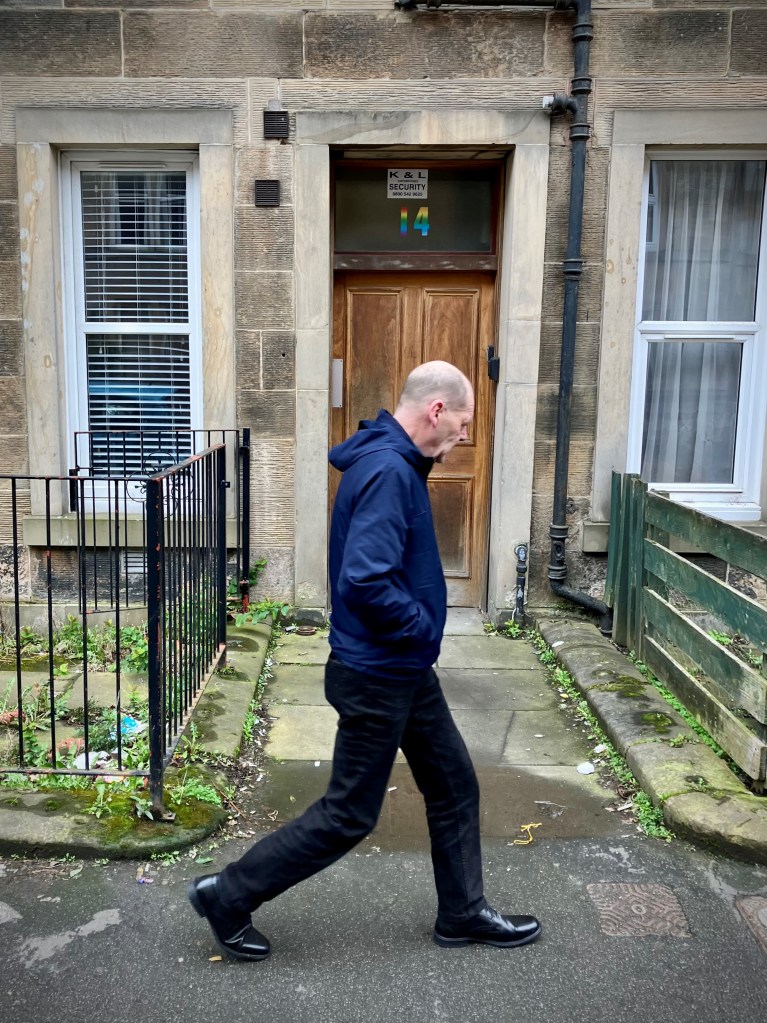
14 Caledonian Place—Built in the 1870s; eight flats entered from the stair, in a street named for its proximity to the Caledonian distillery across Dalry Road, then the largest distillery in Scotland.
Notable former residents include:
1957—Maureen Macrae, aged six, who suffered a month of fatigue, dizziness and nose bleeds before dying in hospital. Doctors informed her father, a house painter, that her bone marrow hadn’t been producing enough red blood cells. She was his only child.
1917—Helen MacDonald, who had worked in a fruit shop in Aberfeldy until she married a house painter, Thomas, who lived in Edinburgh. A few years into their marriage, Thomas joined the Royal Scots and was killed within six weeks of his arrival in France.
1916—Alison Muir, a widow whose son Robert operated a Lewis machine gun in the Somme until he was wounded and taken to a casualty clearing station known as Grove Town, where he remains, in a neat little cemetery by the runway of a regional airfield built in 1924 for cargo planes.
1916—Violet Waddell, a seventeen-year-old girl who was chatting to her aunt one December evening in Stewart Terrace, off Gorgie Road, when there was an explosion in the kitchen of the ground-floor flat of no.5, which blew the window out of its frame. Violet, standing directly across the road from the flat, was showered with shards of glass, which cut her face and damaged her eyes. She was also struck by an enamel basin, but to no great effect. Her aunt was unharmed.
It transpired that gas had accumulated in a cellar due to a defect in the piping, and, when the cellar door was opened, the gas escaped and was ignited by a kitchen burner. Violet sued the corporation’s gas commissioners for £500, and was awarded £250.
A few years later, fully recovered, Violet married a railway porter named Alexander McLeod and moved to a pleasant house in the south of the city. She was sixty when she died of a heart attack one afternoon while visiting a friend in Duddingston.
1911—Jessie Morrison, who lived in a flat with her husband and the eldest child of her daughter, Maria Boyle. She had taken the girl in when Maria and her husband William couldn’t afford to keep her after William lost his job as a railway platelayer.
One Sunday afternoon at the end of January, Jessie answered the door to William, who wanted to know if she knew where his wife was. She didn’t; she hadn’t seen her since Tuesday. William said that Maria had left their home (in Waddell Place, Leith) the previous night, saying that she was going to her mother’s flat with a new pinafore for their daughter. Jessie said she hadn’t come, and hadn’t been expected—no visit had been arranged. Evidently, Maria had lied to her husband. Whatever plans she’d had, she had wanted to keep them a secret from her family. But why? And where was she?
Earlier that day and three miles to the south, an insurance clerk called Eric Wilson had taken a morning walk in the Braid Hills, on the southern edge of the city; a popular spot for a weekend stroll by the burn in the valley or up on the grassy slopes.
He was going down a path that skirted the edge of a sheep pasture when he saw a woman lying in a plantation of trees on the other side of the wire fence that separated the field from the glen. A light blue hat covered her face and she appeared to be asleep.
He shouted at her and rattled the fence, hoping to wake her up, but she didn’t move. It occurred to him that she might be dead, but he lacked the courage to check for himself, so he hurried along the path to Braid farm and asked Mr Smith, the tenant, to come back with him. The farmer climbed over the fence and lifted the woman’s hat. She was not sleeping.
They hurried off to summon the police and, within half an hour, four detectives arrived by taxi, followed by Harvey Littlejohn, professor of Medical Jurisprudence at Edinburgh University. While the police searched the surroundings, Littlejohn examined the body. “The face,” he found, “was covered with blood and froth, and there was blood on both eyes. The ground on which the body was lying showed no sign of struggle, unless under the left foot, where the heel seemed to have made a deep impression.”
He noted bruises and abrasions on the throat, marks of strangulation. The body was stiff, “but there was still some warmth about it”, meaning the woman had not been dead more than six hours—certainly since sometime after midnight.
She was about 30 years old and respectably dressed, although her clothes—a steel grey raincoat, brown skirt, white blouse and a purple cloth jacket trimmed with three stripes of gold braid—were old and shabby. She had false teeth in her upper jaw. She had on a wedding ring.
Bloodhounds were brought in from Haddington. They followed a scent a long distance down through Hermitage wood to the Braid burn that runs through the glen, then lost the trail. It seemed that the killer had waded to the northern bank, unwittingly blotting out his trail.
The body was taken to the city mortuary for a post-mortem examination. Photographs were taken of the woman’s face—portrait and profile, like a mug shot; her hat placed on her head—and distributed to police stations. The profile picture appeared in city newspapers’ early editions.

Members of the public who thought they might know the woman were invited to view the body, but none could be certain (apart from one man, who was absolutely convinced that he knew her, until—only minutes after leaving the mortuary—he met the woman he thought was dead).
Later that afternoon, two constables recognised her as a drunk woman they had cautioned in Leith Street on suspicion of soliciting. They had taken down her name and address: Maria Boyle, 5 Waddell Place, Leith.
Detectives were dispatched to her home—a tenement in the shadow of an engineering works and a brewery near the bottom of Leith Walk. The door was answered by her husband, William, who explained that he had just returned from a fruitless search for his wife.
The detectives took William to the police station, where they showed him the photographs of the dead woman. He “seemed much affected” and said, “Oh my God. It’s like her, but she’s got an awful bashing.” They then took him to the mortuary, where he was shown the body. He confirmed it was Maria, his wife. “The unfortunate man was greatly depressed”, noted The Scotsman.
William was taken back to the station to be interviewed. He told the police that he and Maria had been married for nine years, mostly happily, although Maria had “fallen into intemperate habits” after the Musselburgh races the previous September.
He had no other useful information. He hadn’t known where she might have gone that night, or with whom. About her character, he could say only that she didn’t mix freely with their neighbours, and that she was “an inveterate reader of cheap novels.”
By that evening, the police had a suspect: Alexander Wyse, a 49-year-old railwayman from Fife—“a rough-and-ready chap”—who had been seen by several people in the hours after the murder, walking through Newington, away from the Braid Hills, with blood on his hands and face.
Alexander was arrested at his home in Cowdenbeath, but denied the charge, saying that—as he did regularly—he had gone to Edinburgh to visit his sons, whom he had placed in a Catholic institution there after his wife died.
He said he had then taken “a good deal of drink” in the Grassmarket, where he had been beaten and robbed, which explained the blood, and had then walked out of the town centre looking for a stable to sleep in, which explained his wanderings in the streets near the Braid hills.
He was taken to Calton prison while the investigation continued. In the meantime, his solicitor conducted his own investigations, and, after a week, was able to confirm Wyse’s story and prove that he had indeed been asleep in the stable of a large house when Maria was killed.
Quite clearly, he was not the murderer, so the police fell back on an earlier lead that they had abandoned after they arrested Wyse. A woman from the southside, Jane Webster, had come forward to say she had recognised Maria from the description in the paper. She had been with her on the night she was killed, she said, and was able to describe a few of Maria’s last hours.
She said she had met Maria—who had called herself Norah—in the evening, near the Pleasance, where they had met two or three times before, and they had gone to a pub where Maria bought them a few rounds of whisky. They listened to a street musician, and Maria gave the man a penny. They then went to a tripe shop for supper. A tall working man came into the shop and sat down beside them. The women ordered tripe, the man fish, and he paid for it all. They ate, then left him there.
A short while later, in St Mary’s Street, a young, smartly dressed man—good, dark suit; dickey and tie—beckoned to Maria. They shook hands. Jane remembered he said he was “a maltsman, not a miner” and had then said something about Maria and him taking a walk.
Jane left them to it. She looked back twice, and they were still standing talking. That was the last she saw of Maria.
Tram conductors, cabmen and all the other likely witnesses who had already been questioned were interviewed again, in the hope that they might recognise the description of this new suspect, but, evidently, too much time had passed. No one remembered anything in particular.
The magistrates approved a £100 reward for information leading to the arrest of Maria’s killer, but, again, nothing useful came of it. Eventually, at the end of a short inquest, the procurator fiscal said that it was clear that the police had done everything that could be done. The investigation was at an end. Some crimes are never solved. Some people get away with murder.
No one but the innocent Alexander Wyse was ever charged with the crime, which disappeared from the papers and, not long after, the city’s memory.
1883—Amy Butchart, who was born in the tenement and became an army nurse in 1915. She served on hospital ships in the Dardanelles before being invalided out of overseas service and going to work in a military hospital in Bradford, where, in 1917, she died of a stroke, aged 33.
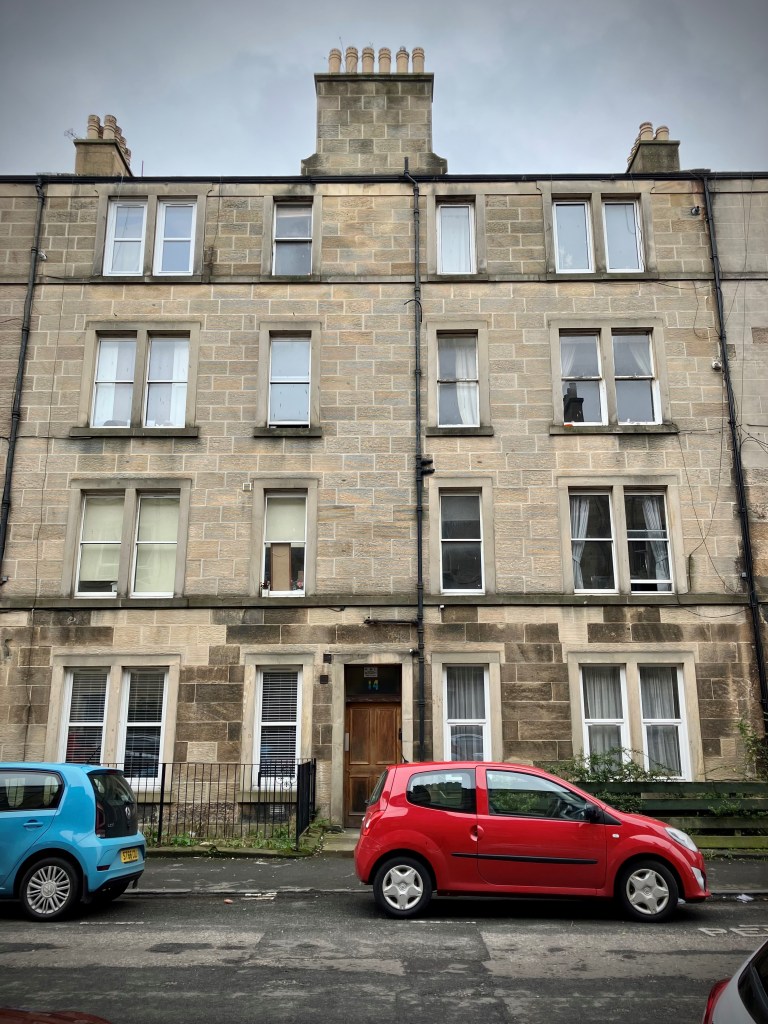
Caledonian Place was part of a working class district built in the former grounds of Dalry House, a 17th-century mansion—still standing, marooned among the tenements—that was the home of local landowner John Chiesley, who was executed for the murder of the Lord President of the Court of Session in 1689. The hand with which Chiesley committed the murder was cut off before he was hanged, and, as seems to be the way of things in this haunted city, his ghost—readily identifiable by its missing appendage—is said to make occasional appearances in the streets that were erected on his property.
 Tenement Town
What a lot of sadness and drama from one tenement, life is so much easier now.
LikeLiked by 1 person
You’re not wrong.
LikeLike
What a lot of twists and turns that Maria Boyle story took!
LikeLiked by 1 person